
Caveat lector: these liner notes are presented as printed—some of the “information” herein is questionable at best!


Back jacket:
Jimmy Doyle and Dan O’Leary play Irish music in the pure Kerry style. They are masters of that idiom that stresses the lively rhythms of the slide and polka as danced in Eastern Kerry. Kerry music maintains a rich full bodied tone and strident drive that give it unique character and those qualities are markedly apparent in Dan and Jimmy’s playing.
Shanachie 29007 ~ 1977 Shanachie Records
Album notes and musically notated tunes played on the album are included inside.
Produced by Richard Nevins and Daniel Michael Collins
Recorded at Crescent Studios, Limerick, Ireland
Jacket art by Brian Mor OíBaoigill
Notes and musical notations by Jean Stewart
Chording and orthography by Jennifer Williams
Inside notes:
Recently I saw a classified ad that appeared in The Irish Post, sandwiched among a half dozen “Irish-gentleman-wishes-to-meet-attractive-middle-aged-lady” ads. It read “Kerryman wishes to meet … ” etc. At the risk of overinterpreting a simple statement, the ad seems an eloquent expression of a sense of cultural identity, obviously the man purchasing advertising space regarded as highly significant the information packed away in the single word “Kerryman.” What’s more, the rest of Ireland seems similarly at pains to set Kerry apart. There’s a cultural stereotype which caricatures that county’s people as bumpkins (and worse) … The image in fact seems very close to America’s 18th-century conception of “the Irish” in general. “Kerry jokes” abound throughout Ireland, in the classic —- and shameful —- mold of our own Polish jokes. When I asked a folklorist friend —- an Irishman who knows Kerry well —- what he makes of this phenomenon, he ascribed it at least in part to the “everybody has to have a scapegoat” phenomenon. He pointed out that as an isolated packet, Kerry “got” the English language later than the rest of Ireland, resulting in an especially thick —- some would say “picturesque” —- dialect with distinctive regional idioms and constructions. Add to this the sort of city-slicker-vs.-country-bumpkin dynamic —- especially prevalent whenever the two cultures come into direct contact with each other, as they do every year when the superlative Kerry football team comes to Dublin to compete —- and I suppose a certain degree of “cultural racism” is predictable.
Whatever the stereotype, Kerry is different, wonderfully so. You don’t have to be an anthropologist to appreciate it: you can hear it in the speech, the music, you can see it in the dance. Even the temperament seems different to me; after weeks spent adapting my own very American social expectations to the courteous reserve of the Irish, I found Kerry people unusually warm and, like their music, straight forward …
But what do I mean by “straightforward music?” Let’s compare the tunes and playing style of Dan O’Leary with that of, say, the great Sligo fiddler Michael Coleman (whose playing has come to be identified with mainstream “Irish” music at its best); the two quantities have about as much in common as Jascha Heifetz [ classical violin ] and Walt Koken [ old-time fiddle & banjo ]. Kerry music has none of the elaborate indirection of the Coleman stylists; its tunes are simple, learnable statements, unobscured by triplets, rolls, etc. Kerry musicians seem less concerned with backup than I’ve generally come to expect of Irish musicians, who usually appear to be more comfortable with a rhythm accompaniment (piano, guitar, banjo). Indeed musicians here provide their own “rhythm section”: even unaccompanied fiddle has such a strongly rhythmic pulse that it sometimes reminds me of Scots fiddling or even Scots piping. (Listen to O’Leary’s solo cut, Side A, Track 4. That polka could almost be a piping march!) Probably this has something to do with the fact that in Kerry, tunes are mostly functional: there seems to be little tradition for “listening” (as opposed to dancing) music, apart from the airs introduced by certain well-traveled musicians like Julia Clifford and her legendary teacher Padraig O’Keeffe and perhaps by the pipers, who may have predated the advent of fiddle in Kerry. This close functional tie between music and dance usually results in the development of highly rhythmic musical forms, whatever the culture; hence in Kerry the fiddle adopts a strong, loud rhythmical style suited to its dance function. Certainly strong fiddle-playing must have been doubly important in the days of early dance instrumentation —- fiddle and melodeon, usually —- the latter being a one-row accordion with a thin, light tone rather like that of the fiddle. In fact it could be argued that this comparatively quiet dance instrumentation might be partially accountable for the development of such a noisy dance: the Kerry Set is punctuated by much stamping by the men, which serves to underscore the beat.
In addition to the rhythmic properties (about which more later) and its clear unornamented melodies, the Kerry musical tradition is characterized by the fiddle’s long biting bowstrokes and absence of vibrato. The repertoire itself is totally distinctive, consisting primarily of slides and polkas, which seem to function much as jigs and reels function elsewhere in Ireland, as the basic tune and dance forms. Their frequency of occurrence in Kerry corresponds to their occurrence in the Kerry Set, in which the polkas predominate by a ratio of 4 polkas to 1 slide and 1 hornpipe. (A full set consists of 6 figures, starting with the 4 polkas danced by a set of 4 couples, followed by the slide —- which tends to be regarded as the heart of the set —- followed by a hornpipe.) Rhythmically the slides and polkas resemble jigs and reels in that they are constructed on variations of 3/4 and 4/4 time, respectively: the technical differences are rather subtle (although the ear knows after one measure!). Slides are apparently identical to single jigs, with melodies which often seem to group themselves most naturally in 12-beat (12/8) phrases. To my ear they set themselves apart from jigs in their characteristic pattern of short and held notes, which accounts for their distinctive lilt. As for polkas, they seem close enough structurally to reels to raise the question of which came first. The polkas seem a simpler form of tune [as] they have fewer notes (more quarter-notes, fewer eighth-notes [ – Jean Stewart notates polkas in 4/4 rather than 2/4 ]), with a strong emphasis on the root of the scale as well as the third and fifth intervals. In fact both slides and polkas strike the listener as simpler forms —- and their style of delivery reinforces that impression: they’re played broadly, without embellishment and with a kind of rhythmic snap. If the word weren’t so unpopular, you might describe them as sounding more ‘primitive’ than jigs and reels … Indeed, one highly credible theory holds that the Kerry music played by such “old-style” players as Dan O’Leary and Jimmy Doyle represents an earlier evolutionary form of music than most of what we find throughout the rest of Ireland … We’ve come to equate “traditional Irish music” with the complex sophistication of the Sligo style of with a somewhat homogenized general ‘idea’ of “Irish music” fostered by Irish Musician’s organizations both in Ireland and the States, sometimes overlooking authentic (and often much more interesting!) regional idioms, as Alan Ward has pointed out … It may be that the forerunners of Ireland’s jigs and reels have been quietly carrying on their own tradition for centuries, unnoticed, in the form of the Kerry slides and polkas.
But it would probably be much more accurate and to the point to confine the foregoing generalities about Kerry music to the particular district that spawned Dan O’Leary and Jimmy Doyle: Sliabh Luachra, “The Rushy Mountain” bordering Kerry and Cork. Certainly the richest and best-documented in Kerry, the musical tradition in Sliabh Luachra can boast one monumental figure in the history of Irish music —- Padraig O’Keeffe —- as well as several lesser known lights. Indeed it seems nearly impossible to separate the general character of Kerry music from the particular influence of O’Keeffe, so powerful and pervasive has been his legacy. There’s no question that O’Keeffe (1888-1963) encouraged, if he didn’t originate, a style of fiddling which incorporated long bowstrokes, some use of open-string drones (notably the G and the D), and frequent use of octaves in twin fiddle-playing. Other effects associated with O’Keeffe (correctly or no) include the scarcity of ornamentations (trebling, rolls, etc.), the occasional use of special tunings for certain tunes, and [a] general tendency to tune the fiddle below concert pitch.
Be that as it may, O’Keeffe was a powerful, even mythic figure in his day … An inspired musician, he was also [a] brilliant and eccentric character, given to drink and garrulous discourse. He maintained an impressive roster of students —- including both Julia (Murphy) Clifford and her brother Denis Murphy —- and spent most of his life as an itinerant teacher, traveling from house to house. He was 26 when Dan O’Leary was born near Killarney, and his teaching area encompassed much of Sliabh Luachra. Dan however studied with another teacher, a similarly colorful character who also exerted a powerful influence on the development of a Sliabh Luachra fiddle style, perhaps second only to the legacy of O’Keeffe: Tom Billy.
Born in Ballydesmond in 1879, Tom Billy was both blind and lame. Nonetheless he had a great many students scattered over a wide territory; he traveled by donkey to each student’s home. Dan describes the routine of learning a new tune from his teacher as follows: “He would play the tune and I would write the notes down (by their letter names), then I would play the tune back and he would listen and tell me what was wrong.” Tom Billy himself had learned from one Patrick Tarrant of Knocknagree (“They played a lot together,” Dan says, “more than any two”), about whom I have found nothing … He may or may not be “Paddy Tarrant” the nephew of fiddler Din Tarrant of Ballydesmond. As far as I can determine, Tom Billy was never recorded; Alan Ward speculates that his playing was probably representative of the general Sliabh Luachra style, possibly sweeter in tone.
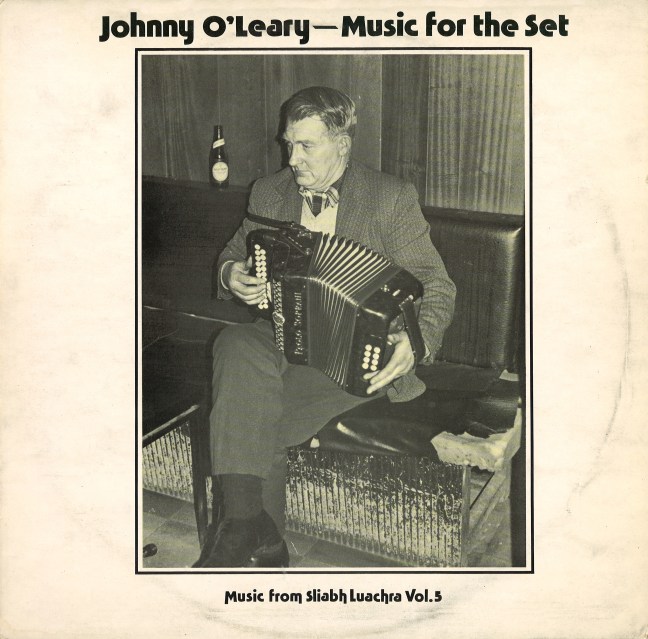
Dan O’Leary (b. 1914) and Jimmy Doyle (b. 1944) both come from the townland of Gib, near Killarney. Dan describers Jimmy’s family as “the most musical family I know around this side of the country”: his mother played the fiddle, his father and both brothers played accordion, and his sister is a good singer. Jimmy learned the accordion from his neighbor (Dan’s nephew) John O’Leary, whom Ward describes as “rather a law unto himself,” in the originality and authority of his playing.
Both Dan and Jimmy talked with me about the changes that have occurred in the dance and music culture in Kerry … Jimmy remembers a time when Johnny O’Leary would come over with 12 to 14 neighbors to play music or cards … “The nights would be long you know … ” And Dan recalls playing in his own home, for his own solitary pleasure, every night of the week. (“It takes away your worries, you know, you forget —-“) He’d hear a tune on the radio and play along with it and in two or three days he’d “have it.” … That was 20 years ago; no one plays in the homes much anymore. “If you want a session you’ve got to go out to a pub.” Why the change? Television, they said. People don’t want to listen to the old music these days, they’d rather watch tv … If you play at home, you bother them. It’s a statement I heard echoed all over Ireland … One aging piper near Dublin confided to me that he hadn’t played his pipes in his home for years, not since his playing had been the focal point of a domestic confrontation in which his wife and kids said they couldn’t hear their tv programs … The crisis had ended in an ultimatum: he was not to play his pipes in the home when his family was there. He shook his head, as hurt as if it had happened yesterday: “I think they just don’t like the old music,” he said.
( Not that Jimmy’s and Dan’s homes are fraught with strife over the issue of their playing at home. On the contrary, Jimmy’s home, for example, was alive with music (and little boys, 4 of them) the night we visited. Two adolescent nieces from the States were also visiting that night, one of them an accomplished fiddler … The little ones were bedded down at a decent hour but one who wanted to be closer to all the excitement chose the kitchen floor instead and sprawled like a puppy on this belly, sound asleep in the front of the sink. There was music long into the night, and warm good feeling … Nor can I imagine two less confrontational types than Dan O’Leary or Jimmy Doyle. Dan is gentle, courtly, diffident, a soft-voiced man of slender frame and twinkling smile … Jimmy is likewise immediately appealing, full of boyish energy and goodheartedness. )
Some intriguing comparisons can be drawn between the musical traditions of Kerry and America. Listen to Dan and Jimmy playing in octaves (as Denis Murphy and Julia Clifford did and as O’Keeffe, Tom Billy, Patrick Tarrant and others had done before them), accordion taking the top part, fiddle the bottom. See if the sound doesn’t remind you of, say, the twin fiddling of the Riendeaus of New Hampshire (French Canadian in origin), or even of early Cajun twin fiddling (French Louisiana), where the second fiddle, in between passages of unison playing or pure “seconding,” occasionally catches bits of the melody played an octave below the first fiddle. Listen also to the simplicity of the slides and polkas and see if you don’t hear Burl Hammons playing West Virginia fiddle tunes. And while you’re listening to old Burl playing ‘Old Sledge’, listen to the “backbeat” in his playing —- how the bow constantly returns to that offbeat note which functions as a kind of drone similar to the fifth string on the old-time banjo … That characteristic backbeat is a strident presence in southern American tunes in 4-time, serving to underscore both the rhythm and the tonal base of the tune … Now play the ‘Blue Ribbon Polkas’ (Side A, Track 1) and hear the upbeats. It’s not hard to pick out the resemblance, given Jimmy’s snappy accentuation of the 2-and 4-beats on accordion.
To any traditional music historian familiar with the Scots-Irish roots of America’s southern mountain music, this striking similarity to the music of Kerry raises some interesting questions. Is it due to nothing more than evolutionary coincidence, or does Kerry music trace its origins to the same (Scottish) source? —- which would of course explain the distinctive Scottish sounding rhythmic drive one hears in Kerry tunes. And if Scots influence truly found its way down to the farthest reaches of southwest Ireland, how did it manage to leave no recognizable trail of Scots-influenced musical styles in bordering regions?
A study of the Kerry tune repertoire might shed some light in this regard; if the Scottish musical tradition did indeed make its mark on Kerry music it would presumably have left a tune legacy as well. In the absence of such research one can only speculate … Certainly the temptation is great to link the Appalachian and Kerry traditions to the same source, but as a colleague said to me, “strong rhythmic bowing is one way to do it. There are lots of ways for music to evolve.” And it’s not uncommon for diverse cultures in geographically separate regions to evolve similar musical forms.
* * *
Dan O’Leary and Jimmy Doyle have been playing regularly together for years, in the dance halls and pubs of Sliabh Luachra: their tune selections here are representative of their repertoire of indigenous slides and polkas (and two jig tracks). Jimmy plays a B/C Italian accordion, though he says he’d rather have a Hohner … Certainly they are two of Kerry’s finest and best-known musicians still playing the old tunes in the old style.
Inquiries in tune origins yield two basic sources: Tom Billy (‘Baile An Tsanhraidh Polka’, ‘Weaver’s Delight’, ‘Gibb Polka’, ‘Bog Road’, and ‘Tom Billy’s Jig’), and Denis Murphy (‘Denis Murphy’s Slides’, ‘Brosna Slides’, —- Denis had got them from three unidentified players from Brosna —- and ‘Padraig O’Keefe’s Slide’). Many remain unidentified: the ‘Listry [Lisheen, do doubt] Slide’ comes “from Gneevgullia evermore”; ‘Thrush on the Strand’ comes from Jimmy who’s been playing it for years and doesn’t remember where he got it, ‘Doyle’s Favorite’ is apparently Jimmy’s own tune, about which Seamus MacMathuna once wrote in ‘Treoir’ that the tune was his (Jimmy’s) favorite polka. Jimmy has since “put a few trims into it.” As for the ‘Blue Ribbon Polka’, Dan says he got it from a James Morrison record brought over by his sister from America. Jimmy says he first heard it played by Johnny Clifford, Julia’s brother [husband!], on piano accordion … To confuse the issue, there’s another polka (not on this recording) by the name of ‘The Blue Riband’, documented by Ward, which John Clifford says he learned for “Dan O’Leary” who says he got it from a recording of Mike Hanafin and Danny Moroney. Perhaps they’re the same tune? Oh well.
* * *
All those interested in further pursuing the music traditions of Kerry owe it to themselves to read Alan Ward’s extraordinarily comprehensive and well-researched (and well-written!) “Music from Sliabh Luachra” (published in coordination with Topic Records’ three[6]-volume Kerry Music series, and also as a part of ‘Traditional Music Magazine’ No. 5, 90 St. Julian’s Farm Rd. London SE27 ORS), on which I have drawn heavily for information. Thanks also to Brendan Breathnach, Mick Moloney, and Barry O’Neill and to William Collins of Cork (now living in Loughrea), who gave us two additional fine tunes for inclusion with the musical notations. ~ Jean Stewart







 The Music of Sliabh Luachra