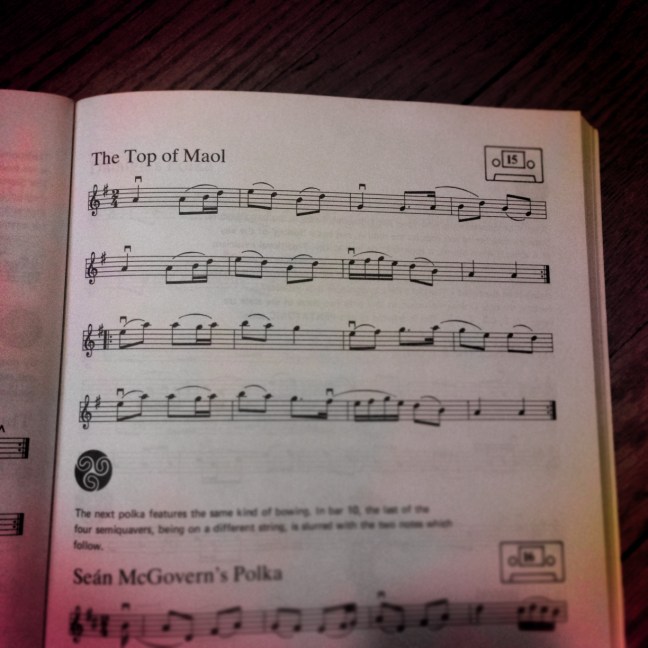
The Top of Maol (polka)

This tune, like so many others, goes by a few names. It’s often called the Queen’s Polka, or sometimes the Groves of Gneeveguilla, but Pádraig O’Keeffe named this tune Top of Maol to commemorate the fact that he could see the top of Sliabh Maol to the northeast from his home at Glountane Cross. Finding the place now can be tricky! What was once called Sliabh Maol is now either Baraveha or Knockfeha, where the Brown Flesk River rises. The bogs of Maol could be part of what are now collectively known as the Mount Eagle bogs, or the adjacent land which has been given over to the forestry schemes which have drastically changed the face of the local countryside. And the townland which was once Maol is now generally referred to as Glanowen. The travelling fiddler Phillip Walsh, who gave his name to Walsh’s Hornpipe, hailed from Maol, and there’s also a little-played reel known as Sliabh Maol. [Many thanks to Donal Cullinane for help with the geography!]

Top of Maol from SLOP
as it appears in Sliabh Luachra on Parade, a collection of Cuz Teahan’s repertoire

https://www.irishtune.info/tune/2630/

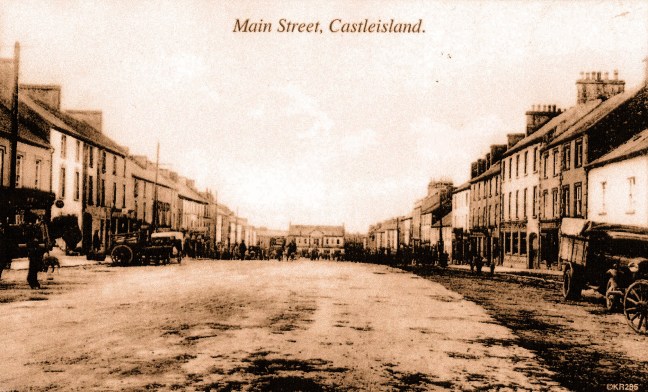
Castleisland

Castleisland (Oileán Ciarraí) could be considered the cultural capital of Sliabh Luachra. The town was long renowned for the width of its main street, and in fact Castleisland was described by one of its most well-known citizens, journalist Con Houlihan, as “not so much a town as a street between two fields”. In addition to being the largest local center of commerce (unless you’re up for braving Tralee or Killarney), Castleisland hosts The Patrick O’Keeffe Traditional Music Festival. Every year during the October bank holiday, the brightest stars of Sliabh Luachra music gather to share the tradition, and the nights are long and yet much too short.

patrickokeeffefestival.com

Patrick O’Keeffe festival on Facebook

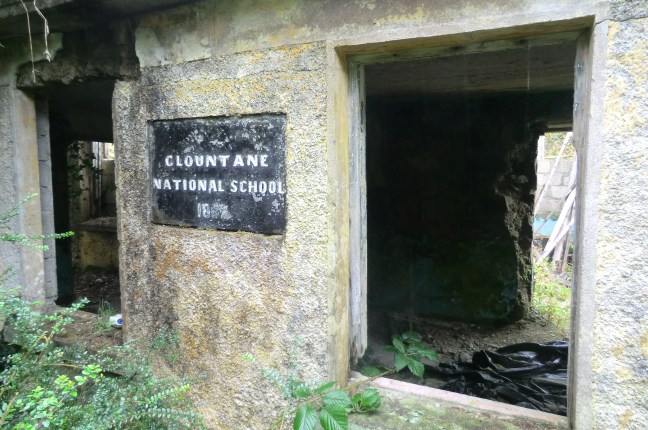
Glountane School

Pádraig O’Keeffe was the schoolmaster here for some time, and though he was remembered by his pupils as a fair, if distracted, tutor, he eventually lost interest in being a teacher and gave it up after only five years for a less stable but wilder life. His father Sean was schoolmaster before him, nicknamed “The Roaster” for being an especially hard disciplinarian, and Pádraig’s sister Nora took over after him. One of his young pupils was Terence “Cuz” Teahan, who grew up to be a notable musician in his own right. In his book, The Road to Glountane, he wrote “Pádraig came to the school when I was probably in the first grade. I had already been three years with his father, Sean O’Keeffe. Then later Nora O’Keeffe Carmody became the teacher. So I had all three while I went to school. The O’Keeffes lived right across the road from the school. You’d have forty-five minutes for lunch, and in the summertime they’d come out with two fiddles and they would march us maybe a mile and a half up the road and back. We were drilled in school. We were drilled by Pádraig O’Keeffe, the whole bit like the army would do around here.”


My Life and Music—Johnny O’Leary

johnny_o'learyI’d really want a whole book to myself to do full justice to music in Sliabh Luachra. Music was always a big thing in my life and I really can’t remember when I started to play. I was twelve and a half when I played for the first time in Thady Willie’s (O’Connor’s) hall in Gneeveguilla – and that’s not today or yesterday!

My Uncle, Dan, God rest him, had a small accordion when I was very young and whenever he’d be out, I’d start. Would you believe that my first ‘box’ cost 12/6 from Clancy’s Killarney and it took my 14 or 15 years to put the price of it together. Things have changed a lot since.

One man I’ll never forget is the late Denis Murphy, Lisheen. We played together for 38 years, sometimes three or four nights a week, and there was never a hard word between us. Whatever one of us would say ‘twas O.K. with the other.

We played in Dan O’Connell’s Knocknagree, on the night before he died. Twas a Sunday night and he never played better. He gave me two reels that nobody in the pub had ever heard before. I asked him for them and his last words were: ‘I’ll give them to the next night …” but I saw him no more.

Denis was a shy man really, but he was very witty and never off form. He had a fierce hatred of microphones and used often say to fellows: “Take that gander’s neck away from me”. He was as gramhar as you’d meet.

Back in the 1930’s and 40’s we hardly missed a wedding or a house dance. We’d often spend a couple of days in a house and they’d be dancing sets day and night. There was hardly any money that time – only plenty of porter.

Patterns were popular too, especially on Sunday evenings. We had Mick Daly’s in Maughantourig and there used to be one at the top of the wood, near Eugie Kelleher’s, on the road to Rathmore. There would often be seven or eight players and smashing jig dancing.

Jig sets were all the go, like the ‘Talavara’, the ‘Cock and the Hen’ and the ‘Jenny Ling’. The polka set is after taking over, but the dances are not near as good. I think that television has ruined music; I mean to say it comes first in most houses. When I was growing up there was an instrument in nearly every home and they’d love a few hours of a session to pass away the time.

Padraig O’Keeffe was another of the characters and one of the best I’ve ever heard. The minute I saw him I knew he was a professional musician. He used to spend a lot of time in Jack Lyon’s Bar in Scartaglen and could write music in the correct way – for any instrument. He had some famous players like Denis Murphy, Julia Clifford, Mikie Duggan, Paddy and Johnny Cronin.

I saw Padraig writing out a tune for Willie Clancy one day and Willie played it perfectly on the tin whistle. Padraig had almighty wit and was always full of roguery. A few drinks would always get him going, but for the last 10 to 15 years of his life he wasn’t inclined to play that much.

He got a ‘weakness’ once in Jack Lyons’, but a drop of brandy brought him round. A few more drinks followed and when one of the prime boys tried to get one from Padraig what did he say only “go away and get a weakness of your own”.
He taught music to half the county around here. He’d know a budding musician a mile away and he met a lot of bad ones too. “A fine thing to teach a Bonham to pray… “ he used say.

When I was learning, I’d often walk the eight or nine miles to Scart to meet him. The weather didn’t matter. It’s a big change now when you can see all the youngsters being driven to music lessons in Gneeveguilla on a fixed night every week.
The blind fiddler, Tom Billy Murphy, from Ballydesmond, was another famous player. He travelled the countryside on the back of a donkey and was well liked wherever he went. In spite of his handicap, he managed well.

Like the rest of them, he was full of humour. One night in Minnie Mac’s behind in Jib, he broke a string. The house was packed, there was only a single burner lamp and sets were flying. Next thing, Tom Billy fixing his fiddle, cocked up his head and said: “High lads, shove out of the light from me”.

Padraig was an awful boyo, of course. He was with Tom Billy and Din Tarrant in Knocknagree on one occasion. Anyway, Tom played a jig that Padraig had not heard before and Padraig asked him to play a second time. He learned it very quickly and then – to tease Tom – he played it on his own. “Blast you”, says Tom, “you’re after making a fool of me”.

Jack Keeffe’s bar in Knocknagree was a favourite haunt at that time. I remember seeing Din Tarrant playing there. He was a big strong man with a hat and very honest. He was a fine musician, renowned for jigs, slides, reels and hornpipes. A good few polkas are called after Din, who died in 1957 aged 81.

That time, the music of Sliabh Luachra wasn’t known as well as it is now. Seamus Ennis did the first radio broadcast in the early 1940’s. People like Sean Mac Reamoinn, Ciaran Mac Mathuna and Sean O Riada came after that. They put Sliabh Luachra music where it is in Ireland today. I’m glad to have known the marvellous musicians of the area and to have played with them all.

A few years ago, when the country began to get more prosperous, I thought that the music would die. People had too much money and they found other things to do. I’m glad to see that it’s back on its feet again. Comhaltas Ceoltoiri Eireann are doing a marvellous job and it’s wonderful to see Nicholas McAuliffe giving classes here in Gneeveguilla.

However, I think there should be more traditional music on television. They had some lovely programmes in the years gone by. No doubt, the radio gives plenty of time to our music.

I love to see the young boys and girls taking an interest. They have every comfort now and are being given plenty of opportunities. The tape recorder is a great help in learning music. Instruments are better too. In the old days when a string would go, you’d have to get a piece of elastic and put it through the key. I often played with five or six elastics.

As far as I can see, there is no danger to Irish music now, particularly Sliabh Luachra music. One thing I’d like to say before I finish is that we can play reels in this part of the country as good as anywhere else and I’d argue that with anyone.
We still have some great talent inn Sliabh Luachra. Jimmy Doyle has more than made a name for himself, on radio, television and record, while Padraig Moynihan, Glenfesk and John Cronin, Killarney are outstanding. We also have Denis McMahon, Ballyhar, Con Carroll, Coolea and Siobhan Collins, Tureenamult, an outstanding flute player who as won an All Ireland, as well as Paudie Gleeson and Artie O’Keeffe.
Of course, we can’t forget. Dan Cronin, Quarry Cross, Kathleen O’Keeffe and Ellen O’Leary, all of whom have been heard on Radio Eireann. Then there is Mick Cronin, Reaboy, the brother of the famour fiddlers, Paddy and Johnny. A man I often play with is Mikie Duggen.

Sliabh Luachra has an abundance of singers, including Hannah Dennehy, a sister of the Cronin brothers; Mary Lenihan, Ballydesmond and Paddy Cremin, who is well-known for that grand old ancient song of the good old days. Jimmy O’Brien, of Killarney is a sweet singer as is his daughter, Siobhan, who has been in many All-Ireland competitions. Paddy Doyle, Maulykevane, is another man well able to give a song, not to speak of Christy Cronin, Tim Gleeson and Bill Keane.

I could keep on going, but we’ll continue the story some other day. I’m delighted to see a group of people coming together to establish Cumann Luachra. Apart altogether from music, our area is full of history and tradition and it is only right that these things should be honoured.

Didn’t we produce two of the best poets in Ireland and there was never a character like Eoin Ruadh. Aren’t they still telling yarns about him… if we could only print them.

Source: Journal of Cumann Luachra, Vol. 1, No. 1

Johnny O’Leary

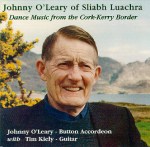
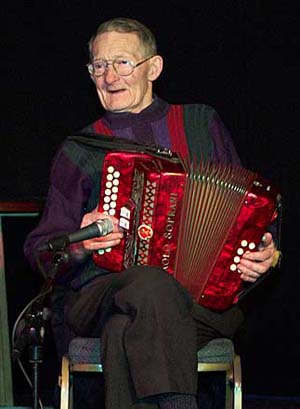
Johnny O’Leary (June 6, 1923 – February 9, 2004) was born in Maulykeavane (Mholl uí Chíobháin, known locally as “Jib”), a few short miles through the fields from Gneeveguillia, in the very heart of Sliabh Luachra. He started picking out tunes on the melodeon at the age of five and by his early teens he was regularly playing for local dances. He played the Paolo Soprani box in C#/D tuning, using the “press and draw” style. He had much of his early tutelage from his uncle Dan O’Leary, and had his first accordion lessons from John Clifford, but later he was a student of Pádraig O’Keeffe. While a teenager he struck up a friendship with Denis Murphy that lasted 37 years, ending with Murphy’s death. Together they were a fixture at Dan O’Connell’s pub in Knocknagree. Breandán Breathnach visited Sliabh Luachra for many years and collected music from O’Leary, and after Breathnach’s death in 1985, Terry Moylan took up the work and published his collection of O’Leary’s music in 1994. Through this book and his commercial recordings, Johnny earned rightful honor as the foremost Sliabh Luachra box player of his generation, and his influence continues to this day.

Learned from: Pádraig O’Keeffe, Dan O’Leary, Din Tarrant, John Clifford

Taught: Mick Culloty

Played with: Denis Murphy, Julia Clifford, Mick Duggan

Recordings:

Johnny O'Leary Music for the Set The Trooper Johnny O'Leary of Sliabh Luachra

More resources:

Snippets of field recordings

Buy the book

In his own words

Julia Clifford

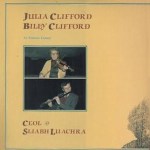
Julia Clifford (June 19, 1914 – June 18, 1997) was born at Lisheen, Gneeveguilla, County Kerry, one of eight Murphy children. Her father Bill played flute, fife, and fiddle and had a fife and drum band. At a young age she picked up the fiddle and showed much promise, and she was sent to be taught by Pádraig O’Keeffe. Perhaps because she learned from him very early on in her development, she is thought to have absorbed and assimilated Pádraig’s style more than any of his pupils. Julia emigrated to Scotland and then London and in 1941 married accordion player John Clifford, also from Sliabh Luachra. Over the years they traveled back and forth between London and Ireland. She recorded extensively in many combinations with her husband, her son Billy, and with her brother Denis. Though she is often overshadowed by Denis’ reputation and more flashy style, she was a true torchbearer of the O’Keeffe style, as well as having her own unique take on the music, and she is rightly considered one of the greats of this music.

Learned from: Pádraig O’Keeffe

Taught: Billy Clifford

Played with: Denis Murphy, Johnny O’Leary, John Clifford

Recordings:

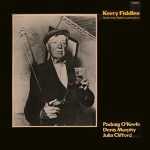
Denis Murphy and Julia Clifford star above the garter 300  Julia and Billy Clifford Ceol as Sliabh Luachra 300  Julia and John Clifford The Humours of Lisheen 300  The Star of Munster Trio 300 Kerry Fiddles 300

More resources:

Snippets of field recordings

In her own words

Alan Ward’s pamphlet about Sliabh Luachra music, with a section on The Waivers and Cliffords

In 2019, Katie Howson organized an incredible, once-in-a-lifetime event honoring Julia’s music, called As I Looked East and I Looked West”. Lot’s of interesting material here: https://katiehowson.co.uk/i-looked-east-and-i-looked-west and on the Facebook page.

One of the great things to come out of that event was this website hosting a huge treasure trove of intimate and informal recordings of Julia playing through her repertoire for the purpose of teaching tunes. You could spend a loooong time here: https://www.juliaclifford.eu/

Denis Murphy

Denis Murphy (November 14, 1910 – April 7, 1974) was born in Lisheen, Gneeveguilla, County Kerry one of eight children of Bill and Mainie (née Corbett) Murphy. The family were known locally as the “Waivers” (to distinguish them from the many other Murphy clans in the area) because in previous generations they had been weavers of flax linen. His father Bill played fife, flute and fiddle and had a fife and drum band, and it’s likely that Denis got much of his early music from his father. Later, he and his sister Julia Clifford were taught fiddle by Pádraig O’Keeffe. Denis emigrated to the United States but returned often to Ireland and returned permanently to Lisheen in 1965. He struck up a musical partnership with box player Johnny O’Leary which lasted for many years until his death. Denis was recorded extensively for the radio and commercial recordings, and his driving, frictionless style has been hugely influential

 Learned from: Bill “The Weaver” Murphy, Pádraig O’Keeffe

 Played with: Julia Clifford, Johnny O’Leary

 Recordings:

Denis Murphy - Music from Sliabh Luachra    Denis Murphy and Julia Clifford star above the garter 300    Kerry Fiddles 300

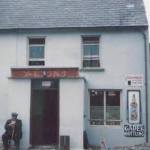
Lyons' Bar 1961 300

More resources:

Snippets of field recordings

Alan Ward’s overview of Sliabh Luachra music, with an extensive section on The Waivers

A New and Exciting Resource:
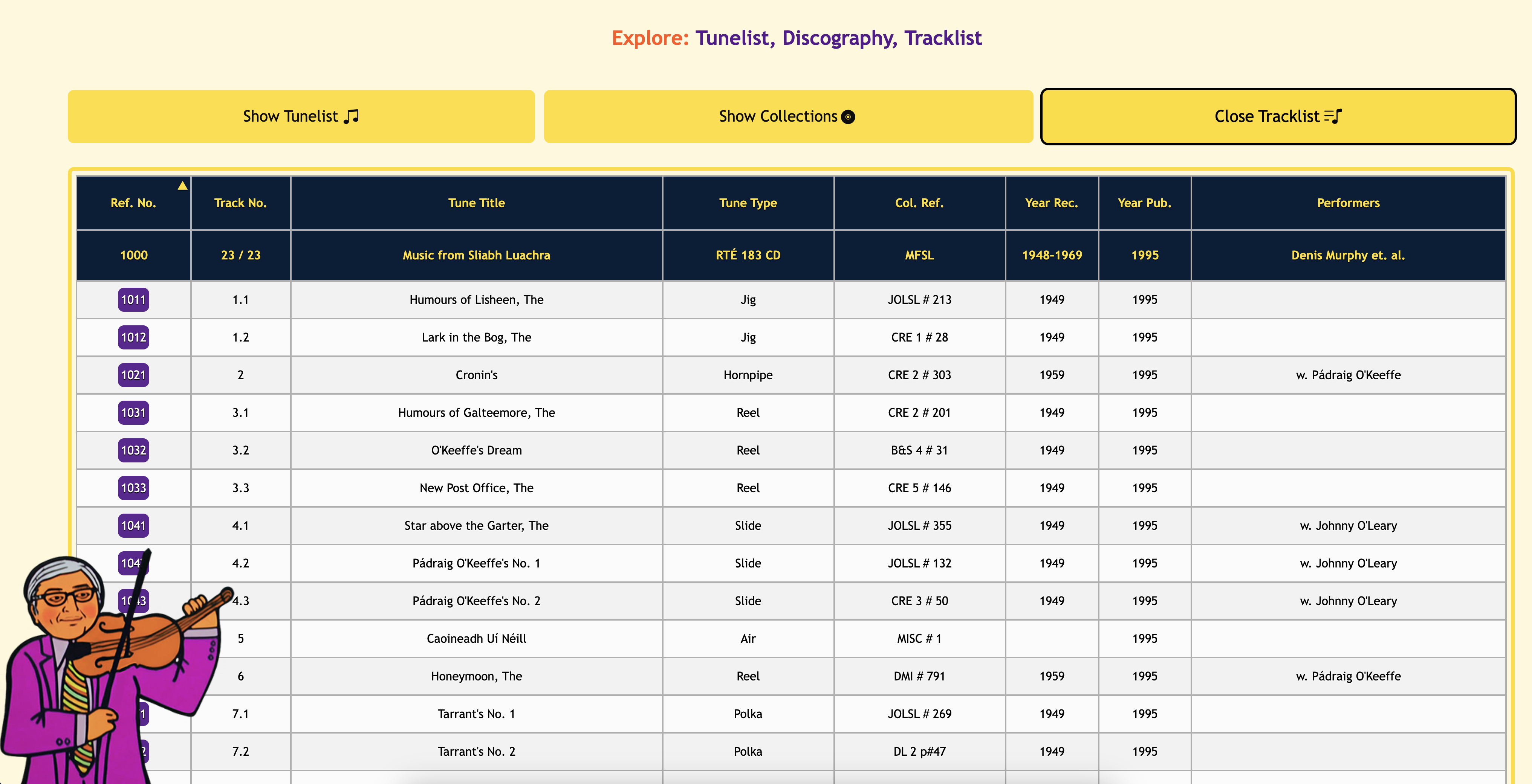
ProjectDenis

ProjectDenis

ProjectDenis is the brainchild of Anton Zille, who was inspired to to catalogue the wealth of Denis Murphy’s wonderful music scattered across the archives, the attics, the largely out-of-print albums and the web in one easy-to-search app. He says: “There are 700-ish items in this work-in-progress database right now, including albums, tapes, 78s, individual tracks and unique tunes, and the more research I do, the more I’m convinced that I’m only just scratching the surface! With so much unexplored material out there, one can be sure they’ll find some gems waiting to be discovered, played and shared – and my app is meant to be a reference map in that search.”

Pádraig O’Keeffe

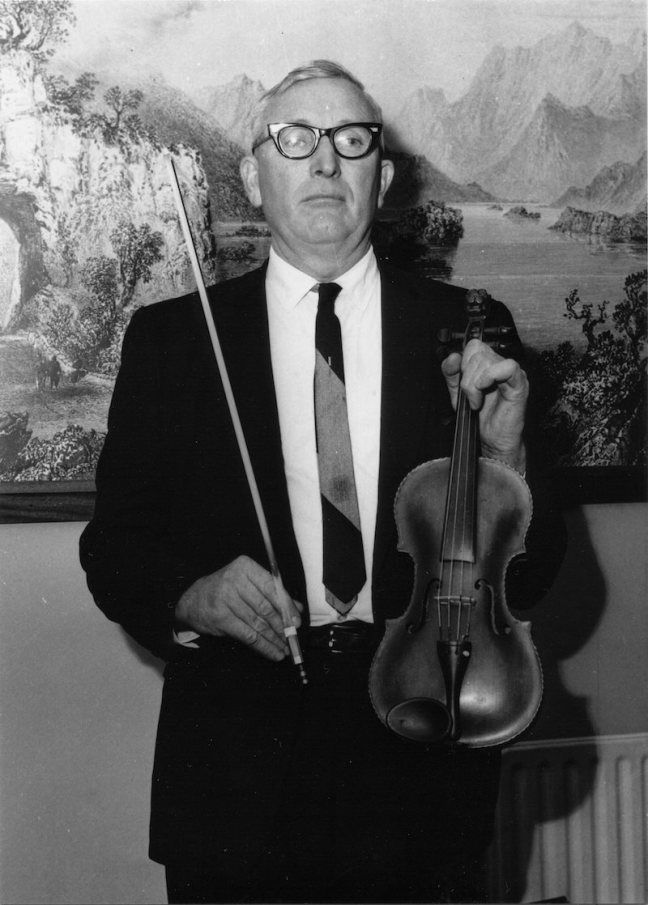
Pádraig O’Keeffe (Irish: Pádraig Ó Caoimh) (1887 – 1963) was born and lived in Glountane Cross near Castleisland, Kerry. He is regarded by many as the towering figure of Sliabh Luachra music, as he was one of the only area musicians of his generation to have been recorded, and throughout his life as a travelling music teacher had countless pupils, many of whom became renowned in their own right. He therefore defines the Sliabh Luachra style to a large degree. Peter Browne has written an extensive biography of O’Keeffe which you can read here.

Learned from: Cal O’Callaghan, Margaret (Callaghan) O’Keeffe, William Fitzgerald, Corney Drew

Taught: Denis Murphy, Julia (Murphy) Clifford, Bridgie (Murphy) Kelliher, Johnny O’Leary, Jack “The Lighthouse” O’Connell, John Clifford, Mick Buckley, Paddy Cronin, Johnny Cronin, Jerry McCarthy, Andrew “Sonny” Riordan, Mike Duggan, Paddy Jones, Jim O’Keeffe, Terence “Cuz” Teahan, John Spillane, Annie Twiss, Maida Sugrue, Brian O’Connor, Pats Connell, Dan O’Connor, Sean B. O’Leary, John Collins, Willy O’Connell

Recordings:

Padraig O'Keeffe The Sliabh Luachra Fiddle Master 300 Kerry Fiddles 300 Lyons' Bar 1961 300

More resources:

Hear snippets of field recordings of Pádraig

A collection of his manuscripts